NSF / ANSI
42
Aesthetic effects
Reduces chlorine taste & odor, particulates, and other aesthetic contaminants. The baseline standard for any drinking-water system.

We are local families too. We cook, bathe, and fill our children's cups from the same regional water. PFAS from decades of industrial activity, hard-water minerals, and softener trade-offs do not disappear because corporations would rather move on. You deserve clear answers, and a practical layer of protection at home.
For decades, manufacturers across Northwest Georgia (NWGA) and Southeast Tennessee (SETN) used PFAS-based chemicals in industrial processes. Wastewater containing PFAS was discharged into the Conasauga River watershed over many years.
In 2024, cities across the region filed lawsuits against chemical manufacturers. National reporting connected the regional legal effort with environmental advocate Erin Brockovich, known for her role in the Hinkley, California contamination case. This is a factual news reference only. It does not imply endorsement of or affiliation with Striplin Ventures.
PFAS don't break down. What went into the watershed decades ago is still detectable today.
The Conasauga River flows through Whitfield County (Dalton), Murray County, and into the Tennessee River system. Communities throughout NW Georgia and SE Tennessee draw drinking water from sources connected to this watershed.
If you live in or near Chattanooga, Dalton, Calhoun, Ringgold, Fort Oglethorpe, or surrounding areas, your water supply exists downstream of one of the most documented PFAS contamination zones in the Southeast.
Reporting on university testing in the region has described PFAS levels in some affected waterways as very high. The reporting we rely on is linked in the sources list below, and results vary by waterway and sampling date.

PFAS are man made chemicals used in carpet backing, stain treatment, firefighting foam and industrial coatings. They do not break down in the environment or in the body. In 2024 the EPA set the first enforceable drinking water limits: 4 parts per trillion for PFOA and 4 parts per trillion for PFOS.
Below are the reported figures for the public water systems in this region, taken from EPA UCMR 5 sampling. These are not estimates from us. They are the numbers the utilities themselves submitted.
| System | PFOA + PFOS | Compounds found | People served | Source |
|---|---|---|---|---|
Dalton Utilities Dalton · Whitfield Co., GA Sampling at the V.D. Parrott plant (Nov 2024 through Sep 2025) put the PFOS and PFOA running averages above the 4 ppt federal limit. Six PFAS compounds were detected under UCMR 5. | 4.3 – 5.3 ppt At or above EPA limit | 6 | 99,315 | Surface water |
City of Calhoun Calhoun · Gordon Co., GA UCMR 5 sampling returned PFAS above the current EPA limit. Calhoun sits downstream of decades of carpet-industry land application in the Coosa basin. | Above 4 ppt At or above EPA limit | 5 | 53,090 | Surface water |
City of Rome Rome · Floyd Co., GA Rome draws from the Oostanaula, which carries flow from the Conasauga watershed. UCMR 5 sampling returned PFAS above the current EPA limit. | Above 4 ppt At or above EPA limit | 5 | 45,586 | Surface water |
Tennessee American Water Chattanooga · Hamilton Co., TN Tennessee River intake. UCMR 5 detections are present but reported below the 4 ppt limit. Detection is not the same as zero exposure, and limits ratchet down over time. | Detected, under 4 ppt Below EPA limit | 3 | 350,000 | Surface water |
Catoosa Utility District Ringgold · Catoosa Co., GA Blended groundwater and purchased surface water. Groundwater sourced from limestone raises hardness relative to river-fed neighbors. | Detected, low Below EPA limit | 2 | 60,000 | Mixed |
Source: EPA UCMR 5 data finder · EPA PFAS national primary drinking water regulation, 2024 · utility consumer confidence reports
Hardness is dissolved calcium and magnesium, measured in grains per gallon. NW Georgia and SE Tennessee split two ways. River fed city systems here run soft to moderately hard, roughly 1.8–7.0 gpg. Private wells sitting on Valley and Ridge limestone run 7–20 gpg, which is hard to very hard.
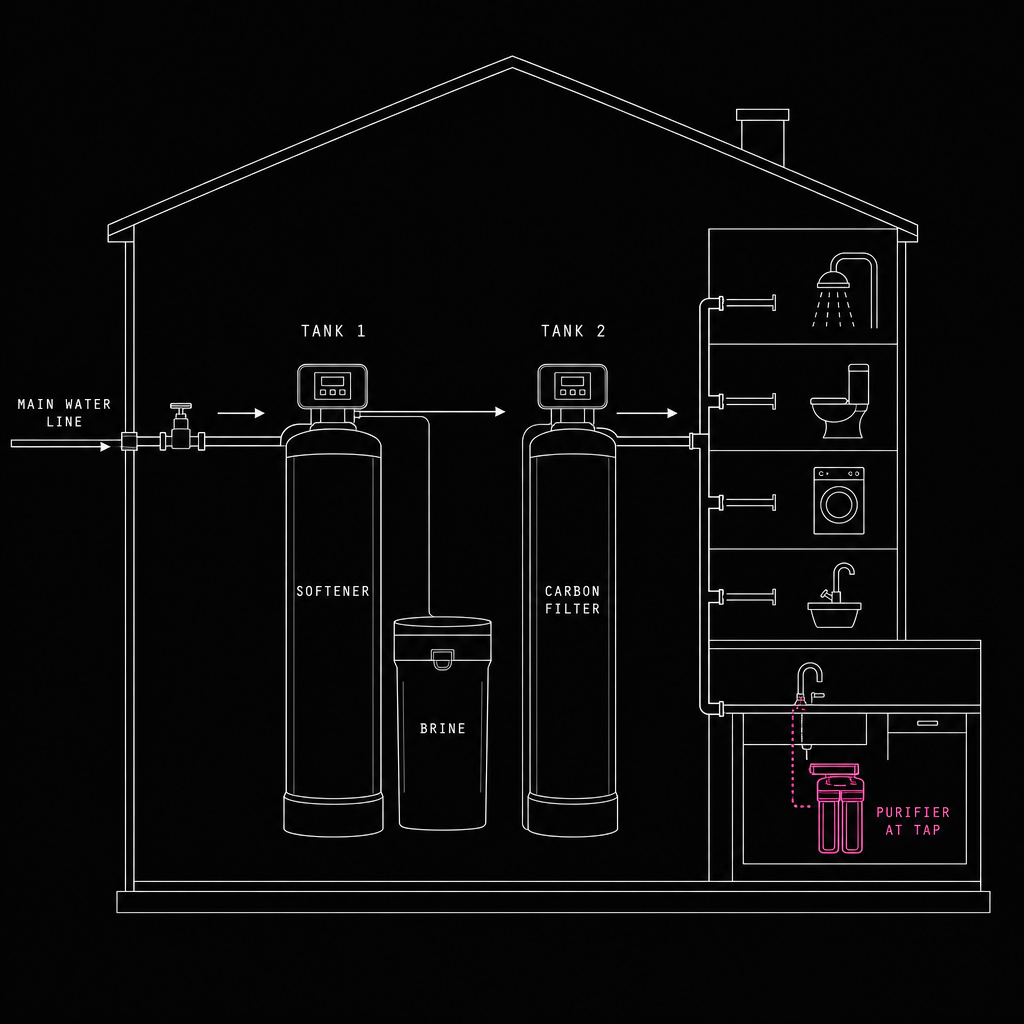
A softener trades calcium for sodium and helps your appliances. It does not remove PFAS. A certified point of use purifier removes contaminants at the kitchen tap and leaves the beneficial minerals in. They solve different problems, and anybody telling you one product does both is selling.
Whole home hardness is handled at the main line with two tanks. Tank one is the softener resin tank, paired with a brine tank that regenerates it. Tank two is carbon filtration for chlorine and taste. Everything downstream, showers, laundry, water heater, runs on treated water, while the certified purifier still sits at the kitchen tap for drinking. Striplin Ventures installs and services both.
Enter your ZIP code and we match it to the public water system that serves it, then pull the reported PFAS and hardness numbers for that system. Well owners get the regional limestone range, because nobody tests private wells for you.
Data: EPA UCMR 5 · EPA PFAS NPDWR 2024 · utility consumer confidence reports · USGS hardness mapping. 5 regional systems tracked.
We live here. We cook here. We fill our children's cups here. Clean water is not a luxury, and a family's well should never become collateral damage for corporate growth.
Georgia's rapid data-center expansion has intensified scrutiny of industrial water demand and local infrastructure, and this pattern is repeating nationwide. On May 20, 2026, a U.S. House hearing put two jars of discolored well water from Morgan County on the national record after residents raised concerns near a large data-center campus. That case is east of Atlanta, not our watershed, but the warning belongs to every American community: growth must not outrun accountability.

This is not what any family wants from the place they call home.
The hearing did not establish that a data center caused the discoloration. It did establish something important: residents deserve testing, transparent answers, and action before uncertainty becomes normal.

PFAS Georgia and community advocates have organized town halls and legal work around PFAS contamination affecting Northwest Georgia. Existing GPB reporting also documents Erin Brockovich's connection to that legal effort. This factual reference does not indicate any endorsement of or affiliation with Striplin Ventures. Advocacy is not a substitute for testing your own water, but it underscores the need for families to make informed choices.
Want to see what's in your own tap water? Look up your ZIP code in the EWG Tap Water Database for a free breakdown of contaminants detected in your local utility's water.
Striplin Ventures is based here, but we don't think water quality should be a postcode lottery. We ship certified purification systems nationwide and offer local professional installation across NW Georgia and SE Tennessee. If you're outside our immediate install area, we can connect you with resources or guide your own installer through the process.
Chelsea K is a PFAS advocate who has been organizing and speaking out for families impacted by water contamination. At a local town hall meeting, she helped a room full of everyday people find their voice, and the crowd was loud. These are your neighbors. They care. And they're in this fight with you.
When you see real locals this fired up, you understand: this issue touches kitchens, schools, and playgrounds. Not headlines, homes.
This video is hosted by YouTube, which can set its own cookies. It loads only if you allow optional cookies.
Chelsea K PFAS Advocate Town Hall Meeting
This video is hosted by YouTube, which can set its own cookies. It loads only if you allow optional cookies.
PFAS Cycle, How It Ends Up In Our Homes
PFAS don't just appear, they travel. This graphic breaks down the full cycle: how these chemicals are manufactured, why they persist for decades, and the pathways that carry them from industrial sites straight into residential water supplies.
Knowing how PFAS gets in is the first step to keeping it out. The right filtration system is designed to break that cycle at your tap.
Striplin Ventures works with multiple trusted brands and manufacturers to match each household with the right certified solution. Here is what to look for in any purifier worth installing under your sink.
We compare certified options across brands and manufacturers, then recommend the system that fits your home during your no-obligation consultation.

Perfect for renters who do not want to void a lease agreement. The unit sits on the counter and connects to your existing faucet with no drilling, no plumbing changes, and no landlord approval required. Because it is not plumbed in, it can be unhooked and taken with you when you move.
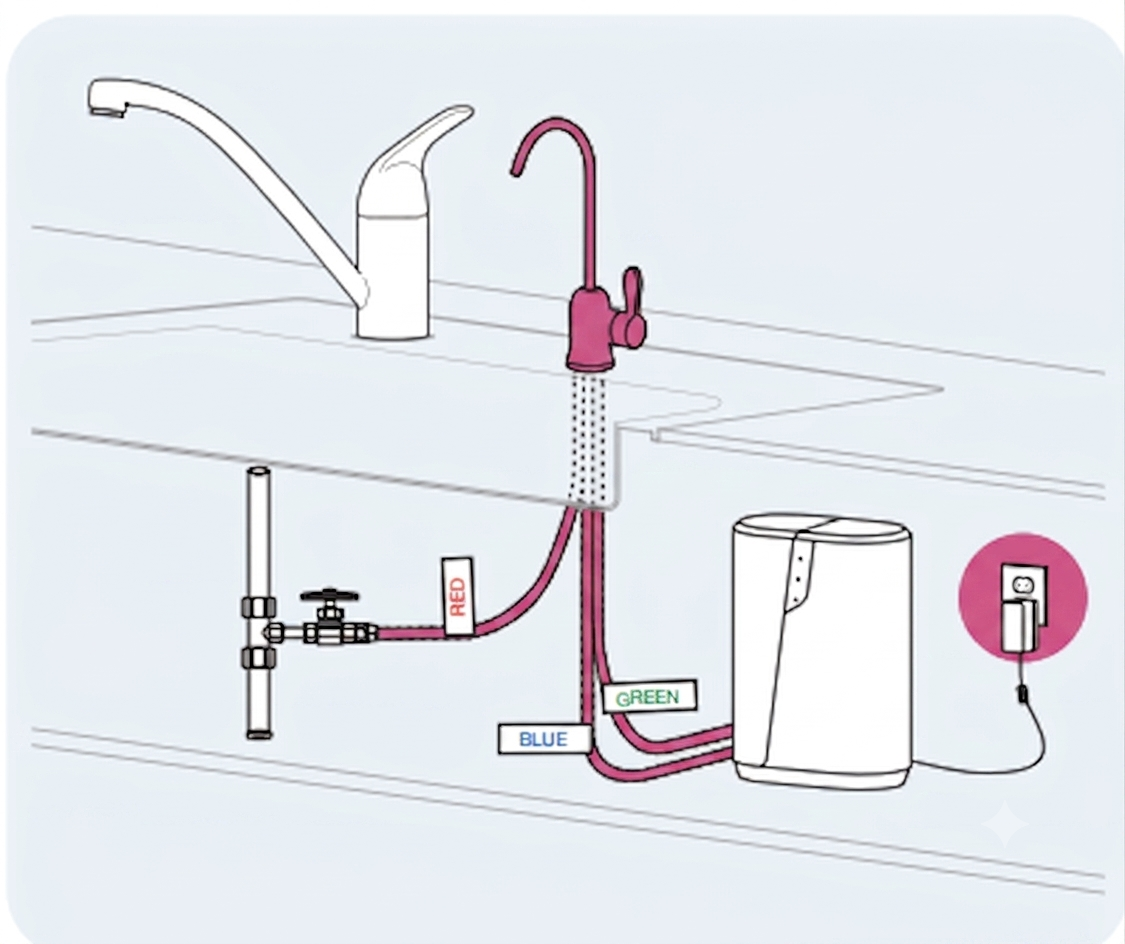
The more permanent option lives under the sink and delivers purified water through a dedicated faucet. Depending on your sink material and cabinet configuration, this install may call for a professional plumber. Your Water Solutions Consultant will confirm the right path during your walk-through.
| Capability | Certified Carbon + UV | Reverse Osmosis | Pitcher Filter |
|---|---|---|---|
| Reduces PFAS | ✓ Certified | ✓ Most | — |
| Reduces Lead | ✓ | ✓ | Partial |
| Addresses bacteria (UV) | ✓ | — | — |
| Keeps minerals | ✓ | — | ✓ |
| Wastes water | No | Yes (~80%) | No |
| NSF certified | 4 standards | Varies | Std 42 only |
| Annual cost to run | Low | Medium | Medium |
Pitcher filters are generally certified for taste and odor. A purifier certified to NSF/ANSI 53 and 401 is tested to reduce specific contaminants, which is a different standard. Check the certification of whatever you buy.
RO systems are sold hard in this region, and they do reduce contaminants. But before you sign for one, know what ownership actually looks like.
Follow the pink line. For every gallon that reaches your glass, three to four more are flushed straight down the drain.
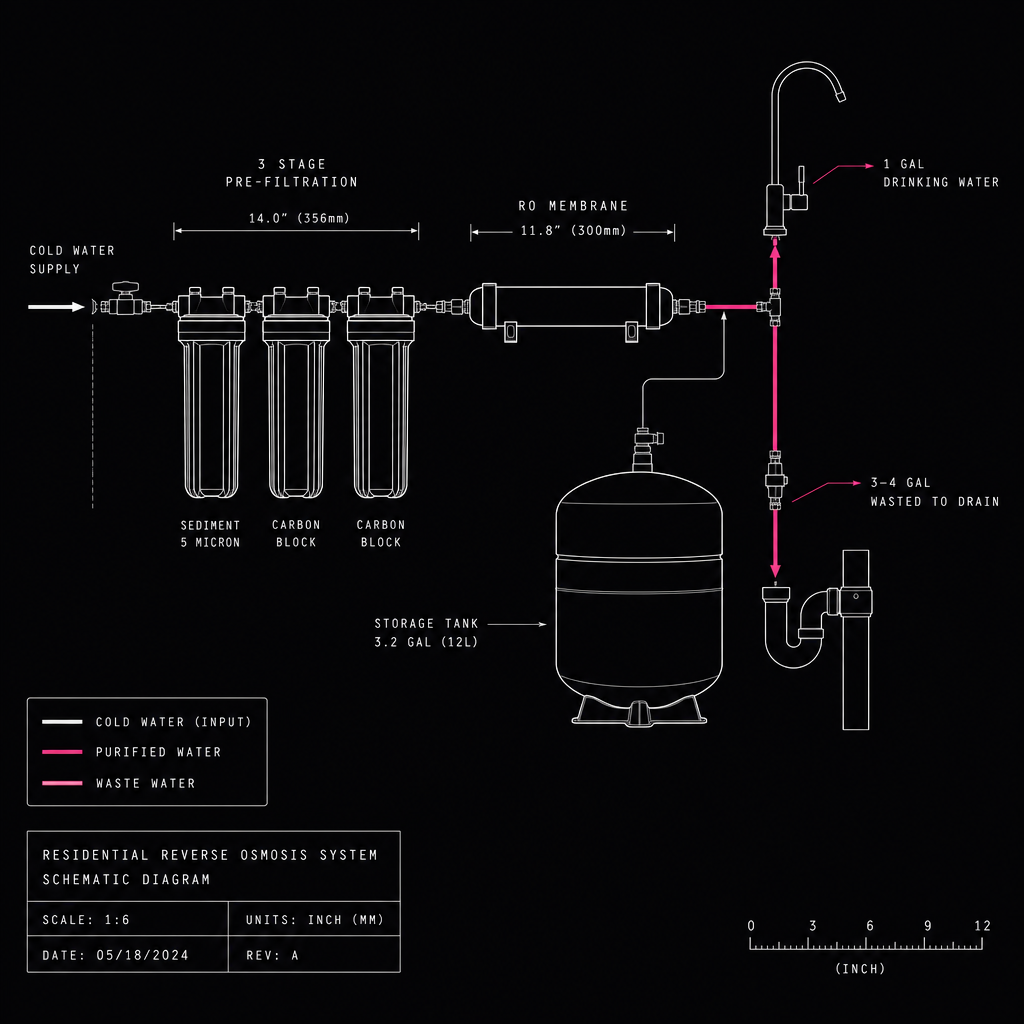
Typical residential reverse osmosis recovers only 20 to 25 percent of the water it takes in. That is a 3:1 to 4:1 reject ratio, so 3 to 4 gallons go down the drain for every gallon you drink. A family of four drinking and cooking with roughly 1,095 gallons a year sends 3,285 to 4,380 gallons to waste.
Most RO units stack sediment, carbon block, the membrane, and a post carbon or remineralizing stage, each on its own schedule. Pre filters run 6 to 12 months, the membrane 2 to 5 years. Budget $90 to $250 a year in consumables, plus the tank and faucet hardware.
The membrane strips total dissolved solids indiscriminately, which takes out the calcium and magnesium along with the contaminants. The result is demineralized, flat tasting water, which is why so many units bolt on a remineralization cartridge to put back what they just removed.
Much of this category is sold by independent sales organizations rather than service companies. When a membrane fails or a warranty claim comes up years later, the original seller is often gone and the unit is orphaned. Ask who services it in year five before you sign anything.
This is exactly why I started Striplin Ventures. Families here were being sold equipment by companies that would not answer the phone a year later. I only recommend certified systems I can stand behind, service locally, and warranty for the long haul, with one filter a year and zero wasted water.
And when a home genuinely calls for reverse osmosis, like very high TDS well water, I sell and service those too. The difference is you get the honest math first, and someone local who picks up the phone after the sale.
Compare certifications, not sales pitches. Your no-obligation consultation includes a full breakdown.
Talk to a local specialistEvery certification below is awarded by an independent third party, not by the manufacturer of the filter. If a system you're shopping for doesn't carry these, ask why.
Reduces chlorine taste & odor, particulates, and other aesthetic contaminants. The baseline standard for any drinking-water system.
Reduces contaminants with established health effects, including lead, cysts, VOCs, and PFAS compounds like PFOA and PFOS.
Covers pharmaceuticals, pesticides, and herbicides that increasingly appear in source water, beyond classic regulatory lists.
Ultraviolet treatment that addresses bacteria and viruses in drinking water, a layer most carbon-only filters cannot provide.
Independent third-party certification that the product meets or exceeds industry standards for contaminant reduction and structural integrity.
The EPA's first enforceable maximum contaminant levels for six PFAS compounds in drinking water, the new floor for what counts as safe.
STRIPLIN VENTURES ONLY RECOMMENDS SYSTEMS CARRYING THESE INDEPENDENT MARKS.
The more we know before the call, the less time you spend explaining and the more time we can spend comparing solutions that fit your home, water, and priorities.

I'm a local entrepreneur originally from Dalton, Georgia. Water quality became a focus because the PFAS data in our region is genuinely alarming, and it's not just here. Data centers and industrial activity are expanding across the country, bringing water accountability questions to communities that never expected them. Most homeowners have never heard about what's actually in their tap.
I'm not a corporation. I'm a neighbor who looked into this and decided to do something about it. Systems ship nationwide. Local professional installation is available across NW Georgia and SE Tennessee. If you're outside that area, we'll guide you or your installer through every step.
If you have questions about what's in your water, you will get straight answers. If a certified purifier is right for your home, your consultant will help you choose one and coordinate the installation approach that fits your kitchen.
Originally from Dalton · Striplin Ventures · Shipping Nationwide
We fulfill certified purification systems nationwide. Local professional installation is available across Northwest Georgia and Southeast Tennessee. Outside that footprint install gets trickier, so we ship the system and coordinate with the customer or their installer. Wherever your people are, if they drink water they are a candidate, and you get paid for the referral.
Straight answers. No pressure. Real earning opportunity.
No, and that's intentional. A point-of-use drinking-water purifier removes contaminants while keeping beneficial minerals like calcium and magnesium. If you have scale on faucets, glassware, or your water heater, you want a whole-house softener in addition to a purifier, not instead of it. Your Water Solutions Consultant will help you figure out what your home actually needs.
This complimentary, no-obligation 20-minute consultation covers what's in your water, which certifications matter, and whether you need a purifier, a softener, or both.
Request my no-obligation consultation